
Poet Sylvia Plath
Born October 27, 1932
Death February 11, 1963
BLOG SESSION
December 17, 2017
Welcome back to our Blog Session Poets & Poetry Lovers. We'll be discussing Poet Sylvia Plath today. We also welcome all Artists, Authors, Writers, aspiring authors, emerging authors, and creatives of all genres to our Session today.
If you would, please grab your Journal to take notes...

Journal Notes
Sylvia Plath was an American poet, novelist, and short story writer. Plath was born in Boston, and she studied at Smith College and Newnham College at the University of Cambridge before receiving acclaim as a poet and writer. Plath married fellow poet Ted Hughes in 1956, and they lived together in the United States and then in England. The couple had two children, Frieda and Nicholas, before separating in 1962.
Plath was clinically depressed for most of her adult life, and was treated multiple times with electroconvulsive therapy (ECT). She took her own life in 1963.
Plath is credited with advancing the genre of confessional poetry and is best known for two of her published collections, The Colossus and Other Poems and Ariel, and The Bell Jar, a semi-autobiographical novel published shortly before her death. In 1982, she won a posthumous Pulitzer Prize for The Collected Poems.
Plath was born on October 27, 1932, in Boston's Jamaica Plain neighborhood. Her mother, Aurelia Schober Plath (1906–1994), was a second-generation American of Austrian descent, and her father, Otto Plath (1885–1940), was from Grabow, Germany. Plath's father was an entomologist and a professor of biology at Boston University who authored a book about bumblebees.
On April 27, 1935, Plath's brother Warren was born, and in 1936 the family moved from 24 Prince Street in Jamaica Plain, Massachusetts, to 92 Johnson Avenue, Winthrop, Massachusetts. Plath's mother, Aurelia, had grown up in Winthrop, and her maternal grandparents, the Schobers, had lived in a section of the town called Point Shirley, a location mentioned in Plath's poetry. While living in Winthrop, eight-year-old Plath published her first poem in the Boston Herald's children's section. Over the next few years, Plath published multiple poems in regional magazines and newspapers. At age 11, Plath began keeping a journal. In addition to writing, she showed early promise as an artist, winning an award for her paintings from the Scholastic Art & Writing Awards in 1947. "Even in her youth, Plath was ambitiously driven to succeed". Plath also had an IQ of around 160.
Otto Plath died on November 5, 1940, a week and a half after Plath's eighth birthday, of complications following the amputation of a foot due to untreated diabetes. He had become ill shortly after a close friend died of lung cancer. Comparing the similarities between his friend's symptoms and his own, Otto became convinced that he, too, had lung cancer and did not seek treatment until his diabetes had progressed too far. Raised as a Unitarian Christian, Plath experienced a loss of faith after her father's death and remained ambivalent about religion throughout her life. Her father was buried in Winthrop Cemetery, Massachusetts. A visit to her father's grave later prompted Plath to write the poem Electra on Azalea Path. After Otto's death, Aurelia moved her children and her parents to 26 Elmwood Road, Wellesley, Massachusetts in 1942. In one of her last prose pieces, Plath commented that her first nine years "sealed themselves off like a ship in a bottle—beautiful inaccessible, obsolete, a fine, white flying myth". Plath attended Bradford Senior High School (now Wellesley High School) in Wellesley, graduating in 1950. Just after graduating from high school, she had her first national publication in the Christian Science Monitor.
Plath first met poet Ted Hughes on February 25, 1956, at a party in Cambridge. In a 1961 BBC interview (now held by the British Library Sound Archive), Plath describes how she met Ted Hughes:
Plath described Hughes as "a singer, story-teller, lion and world-wanderer" with "a voice like the thunder of God".
Ted Hughes & Sylvia Plath
The couple married on June 16, 1956, at St. George the Martyr, Holborn (now in the London Borough of Camden) with Plath's mother in attendance, and spent their honeymoon in Benidorm, Spain. Plath returned to Newnham in October to begin her second year. During this time, they both became deeply interested in astrology ans the supernatural, using Ouija boards.
In June 1957, Plath and Hughes moved to the United States, and from September, Plath taught at Smith College, her alma mater. She found it difficult to both teach and have enough time and energy to write and in the middle of 1958, the couple moved to Boston. Plath took a job as a receptionist in the psychiatric unit of Massachusetts General Hospital and in the evening sat in on creative writing seminars given by poet Robert Lowell (also attended by the writers Anne Sexton and George Starbuck).
Both Lowell and Sexton encouraged Plath to write from her experience and she did so. She openly discussed her depression with Lowell and her suicide attempts with Sexton, who led her to write from a more female perspective. Plath began to conceive of herself as a more serious, focused poet and short-story writer. At this time Plath and Hughes first met the poet W. W. Merwin, who admired their work and was to remain a lifelong friend. Plath resumed psychoanalytic treatment in December, working with Ruth Beuscher.
Yaddo Artist Colony
Saratoga Springs, New York State
Plath and Hughes traveled across Canada and the United States, staying at the Yaddo Artist Colony in Saratoga Springs, New York State in late 1959. Plath says that it was here that she learned "to be true to my own weirdnesses", but she remained anxious about writing confessionally, from deeply personal and private material. The couple moved back to England in December 1959 and lived in London at 3 Chalcot Square, near the Primrose Hill area of Regent's Park, where an English Heritage plaque records Plath's residence. Their daughter Frieda was born on April 1, 1960, and in October, Plath published her first collection of poetry, The Colossus.
In February 1961, Plath's second pregnancy ended in miscarriage; several of her poems, including "Parliament Hill Fields", address this event. In a letter to her therapist, Plath wrote that Hughes beat her two days before the miscarriage. In August she finished her semi-autobiographical novel The Bell Jar and immediately after this, the family moved to Court Green in the small market town of North Tawton in Devon. Nicholas was born in January 1962. In mid-1962, Hughes began to keep bees, which would be the subject of many Plath poems.
In 1961, the couple rented their flat at Chalcot Square to Assia and David Wevill. Hughes was immediately struck with the beautiful Assia, as she was with him. In June 1962, Plath had had a car accident which she described as one of many suicide attempts. In July 1962, Plath discovered Hughes had been having an affair with Assia Wevill and in September the couple separated.
Beginning in October 1962, Plath experienced a great burst of creativity and wrote most of the poems on which her reputation now rests, writing at least 26 of the poems of her posthumous collection Ariel during the final months of her life. In December 1962, she returned alone to London with their children, and rented, on a five-year lease, a flat at 23 Fitzroy Road—only a few streets from the Chalcot Square flat. William Butler Yeats once lived in the house, which bears an English Heritage blue plaque for the Irish poet. Plath was pleased by this fact and considered it a good omen.
The northern winter of 1962–1963 was one of the coldest in 100 years; the pipes froze, the children—now two years old and nine months—were often sick, and the house had no telephone. Her depression returned but she completed the rest of her poetry collection which would be published after her death (1965 in the UK, 1966 in the US). Her only novel, The Bell Jar, was released in January 1963, published under the pen name Victoria Lucas, and was met with critical indifference.Sylvia Plath's Final depressive episode and death

Sylvia Plath's suicide
[not the actual site-an enactment]
Before her death, Plath tried several times to take her own life. On August 24, 1953, Plath overdosed on pills in the cellar of her mother's home. In June 1962, Plath drove her car off the side of the road, into a river. When questioned about the incident by police, she admitted to trying to take her own life.
In January 1963, Plath spoke with Dr. John Horder, her GP and a close friend who lived near her. She described the current depressive episode she was experiencing; it had been ongoing for six or seven months. While for most of the time she had been able to continue working, her depression had worsened and become severe, "marked by constant agitation, suicidal thoughts and inability to cope with daily life." Plath struggled with insomnia, taking medication at night to induce sleep, and frequently woke up early. She lost 20 pounds. However, she continued to take care of her physical appearance and did not outwardly speak of feeling guilty or unworthy.
Horder prescribed her an antidepressant, a monoamine oxidase inhibitor, a few days before her suicide. Knowing she was at risk alone with two young children, he says he visited her daily and made strenuous efforts to have her admitted to a hospital; when that failed, he arranged for a live-in nurse. Commentators have argued that because antidepressants may take up to three weeks to take effect, her prescription from Horder would not have taken full effect.
The nurse was due to arrive at 9:00 the morning of February 11, 1963, to help Plath with the care of her children. Upon arrival, she could not get into the flat, but eventually gained access with the help of a workman, Charles Langridge. They found Plath dead of carbon monoxide poisoning with her head in the oven, having sealed the rooms between her and her sleeping children with tape, towels and cloths. At approximately 4:30 am, Plath had placed her head in the oven, with the gas turned on. She was 30 years old.
Some have suggested that Plath had not intended to kill herself. That morning, she asked her downstairs neighbor, a Mr. Thomas, what time he would be leaving. She also left a note reading "Call Dr. Horder," including the doctor's phone number. Therefore, it is argued Plath turned on the gas at a time when Mr. Thomas would have been able to see the note. However, in her biography Giving Up: The Last Days of Sylvia Plath, Plath's best friend, Jillian Becker wrote, "According to Mr. Goodchild, a police officer attached to the coroner's office ... [Plath] had thrust her head far into the gas oven... [and] had really meant to die." Dr. Horder also believed her intention was clear. He stated that "No one who saw the care with which the kitchen was prepared could have interpreted her action as anything but an irrational compulsion." Plath had described the quality of her despair as "owl's talons clenching my heart." In his 1971 book on suicide, friend and critic Al Alvarez claimed that Plath's suicide was an unanswered cry for help, and spoke, in a BBC interview in March 2000, about his failure to recognize Plath's depression, saying he regretted his inability to offer her emotional support: "I failed her on that level. I was thirty years old and stupid. What did I know about chronic clinical depression? [...] She kind of needed someone to take care of her. And that was not something I could do."
An inquiry on the day following Plath's death gave a ruling of suicide. Hughes was devastated; they had been separated six months. In a letter to an old friend of Plath's from Smith College, he wrote, "That's the end of my life. The rest is posthumous." Plath's gravestone, in Heptonstall's parish churchyard of St. Thomas the Apostle, bears the inscription that Hughes chose for her: "Even amidst fierce flames the golden lotus can be planted." Biographers variously attribute the source of the quote to the Hindu text, the Bhagavad Gita or to the 16th-century Buddhist novel Journey to the West written by Wu Cheng'en.
The gravestone has been repeatedly vandalized by those aggrieved that "Hughes" is written on the stone; they have attempted to chisel it off, leaving only the name "Sylvia Plath." When Hughes' mistress Assia Wevill killed herself and their four-year-old daughter Shura in 1969, this practice intensified. After each defacement, Hughes had the damaged stone removed, sometimes leaving the site unmarked during repair. Outraged mourners accused Hughes in the media of dishonoring her name by removing the stone. Wevill's death led to claims that Hughes had been abusive to both Plath and Wevill. Radical feminist poet Robin Morgan published the poem "Arraignment", in which she openly accused Hughes of the battery and murder of Plath. There were lawsuits, Morgan's 1972 book Monster which contained that poem was banned, and underground, pirated feminist editions of it were published. Other feminists threatened to kill Hughes in Plath's name. Plath's poem "The Jailor", in which the speaker condemns her husband's brutality, was included in the 1970 anthology Sisterhood is Powerful: An Anthology of Writings From The Women's Liberation Movement.
In 1989, with Hughes under public attack, a battle raged in the letters pages of The Guardian and The Independent. In The Guardian on April 20, 1989, Hughes wrote the article "The Place Where Sylvia Plath Should Rest in Peace": "In the years soon after [Plath's] death, when scholars approached me, I tried to take their apparently serious concern for the truth about Sylvia Plath seriously. But I learned my lesson early. [...] If I tried too hard to tell them exactly how something happened, in the hope of correcting some fantasy, I was quite likely to be accused of trying to suppress Free Speech. In general, my refusal to have anything to do with the Plath Fantasia has been regarded as an attempt to suppress Free Speech [...] The Fantasia about Sylvia Plath is more needed than the facts. Where that leaves respect for the truth of her life (and of mine), or for her memory, or for the literary tradition, I do not know." Hughes died in 1998.
On March 16, 2009, Nicholas Hughes, the son of Plath and Hughes, hanged himself at his home in Fairbanks, Alaska, following a history of depression. Their daughter, Frieda Hughes, is now a writer and artist in her own right.

Frieda Hughes
NOTES: Smith College, Plath's alma mater, holds Sylvia Plath's literary papers in the Smith College Library.
Plath's letters were published in 1975, edited and selected by her mother Aurelia Plath. The collection, Letters Home: Correspondence 1950–1963, came out partly in response to the strong public reaction to the publication of The Bell Jar in America. Plath began keeping a diary from the age of 11 and continued doing so until her suicide. Her adult diaries, starting from her first year at Smith College in 1950, were first published in 1982 as The Journals of Sylvia Plath, edited by Frances McCullough, with Ted Hughes as consulting editor. In 1982, when Smith College acquired Plath's remaining journals, Hughes sealed two of them until February 11, 2013, the 50th anniversary of Plath's death.
During the last years of his life, Hughes began working on a fuller publication of Plath's journals. In 1998, shortly before his death, he unsealed the two journals, and passed the project onto his children by Plath, Frieda and Nicholas, who passed it on to Karen V. Kukil. Kukil finished her editing in December 1999, and in 2000 Anchor Books published The Unabridged Journals of Sylvia Plath (Plath 2000). More than half of the new volume contained newly released material; The American author Joyce Carol Oates hailed the publication as a "genuine literary event". Hughes faced criticism for his role in handling the journals: he claims to have destroyed Plath's last journal, which contained entries from the winter of 1962 up to her death. In the foreword of the 1982 version, he writes, "I destroyed [the last of her journals] because I did not want her children to have to read it (in those days I regarded forgetfulness as an essential part of survival)."

Sylvia Plath
The Bell Jar
Plath's semi-autobiographical novel, which her mother wished to block, was published in 1963 and in the US in 1971. Describing the compilation of the book to her mother, she wrote, "What I've done is to throw together events from my own life, fictionalising to add colour – it's a pot boiler really, but I think it will show how isolated a person feels when he is suffering a breakdown.... I've tried to picture my world and the people in it as seen through the distorting lens of a bell jar". She described her novel as "an autobiographical apprentice work which I had to write in order to free myself from the past". She dated a Yale senior named Dick Norton during her junior year. Norton, upon whom the character of Buddy in The Bell Jar is based, contracted tuberculosis and was treated at the Ray Brook Sanatorium near Saranac Lake. While visiting Norton, Plath broke her leg skiing, an incident that was fictionalized in the novel. Plath also used the novel to highlight the issue of women in the workforce during the 1950s. She strongly believed in their abilities to be writers and editors, while society forced them to fulfill secretarial roles.
Whatever happened to Ted Hughes? ~ The Controversy . . .
As Hughes and Plath were legally married at the time of her death, Hughes inherited the Plath estate, including all her written work. Hughes has been condemned repeatedly for burning Plath's last journal, saying he "did not want her children to have to read it." He lost another journal and an unfinished novel and instructed that a collection of Plath's papers and journals should not be released until 2013. Hughes has been accused of attempting to control the estate for his own ends, although royalties from Plath's poetry were placed into a trust account for their two children, Frieda and Nicholas.
Still the subject of speculation and opprobrium in 1998, Hughes published Birthday Letters that year, his own collection of 88 poems about his relationship with Plath. Hughes had published very little about his experience of the marriage and Plath's subsequent suicide, and the book caused a sensation, being taken as his first explicit disclosure, and it topped best seller charts. It was not known at the volume's release that Hughes was suffering from terminal cancer and would die later that year. The book went on to win the Forward Poetry Prize, the T. S. Eliot Prize for Poetry, and the Whitbread Poetry Prize. The poems, written after Plath's death, in some cases long after, try to find a reason why Plath took her own life.
In October 2015 the BBC Two documentary Ted Hughes: Stronger Than Death examined Hughes' life and work and included audio recordings of Plath reciting her own poetry. Their daughter Frieda spoke for the first time about her mother and father.
In 2017 it was revealed that letters written by Plath between February 18, 1960 and February 4, 1963 claim that Hughes beat Plath two days before she had a miscarriage in 1961, and that Hughes told Plath he wished that she was dead. The letters were sent to Dr. Ruth Barnhouse (then Dr. Ruth Beuscher). [Portions of this writing available under the Creative Commons Attribution-ShareAlike License - Wikipedia®]
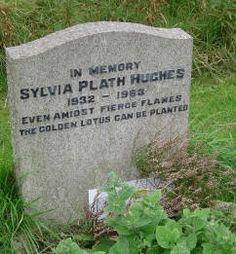
IN MEMORY
SYLVIA PLATH HUGHES
1932 - 1963

OUR NEXT BLOG SESSION:
Frieda Hughes
English Poet & Painter
Until our next Blog Session Poets & Poetry Lovers ~
Peace, Love & Light
By René Allen
©Copyright - René Allen - 2014-2017 - All Rights Reserved


